multiplicationprintablesmath practiceelementary
Multiplication Printable Activities: A Practical Guide
A practical guide to multiplication printable activities, with a skill-by-skill table, short-session tips, and a calm way to practice those facts at home.
Practice one idea at a time, on one page
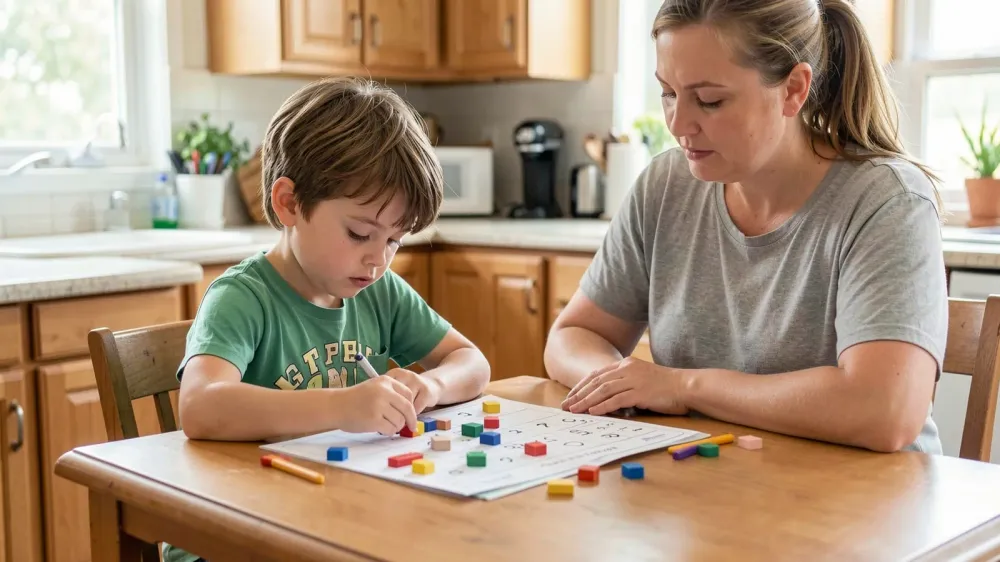
Multiplication printable activities are useful when they match the idea the child is actually learning: groups, arrays, skip counting, or a small set of facts, not a random mixed sheet that feels like a quiz. A good page is short, readable, and finished in a sitting that still leaves everyone speaking to each other.
This is home practice, not a complete math program and not a diagnosis of how a child “should” be doing by a certain birthday. Schools and families teach multiplication in different orders. Follow the method the child already sees in class if they have one, so you are not teaching two languages at once. If a child is unusually distressed by math, or if you have a concern about vision, hearing, or development, talk with the teacher and, if needed, the child’s health care provider. A printable will not settle those questions.
The CDC’s milestone resources are written mostly for younger childhood, but they are still a useful official reminder that children do not move in lockstep. Use that spirit here: adjust the page, do not scold the child for being on a different step.
A table of printables by the job they do
| If the child is working on… | A printable that helps | What you do together | A page to save for later |
|---|---|---|---|
| Seeing multiplication as groups | Pictures of equal groups, with space to write a sentence such as “4 groups of 2” | Count one group, then the groups, then the total; use buttons or cereal as counters if you like, then put food back in the kitchen | A timed grid of mixed facts |
| Arrays | A grid of rows and columns, or a blank grid to color | Build the same array with cubes or pennies, then draw it | A worksheet that jumps straight to 7 × 8 with no picture |
| Skip counting | A number line or a hundred chart with a pattern to color | Count aloud together, then have the child color the jumps | A long mixed page that assumes the pattern is already automatic |
| A small set of facts, such as twos and fives | A short practice of only those facts, with a few arrays in the margin | Practice a little, then stop; come back tomorrow | A “100 facts” challenge page as a first step |
| The relationship with division | A page that shows one array and asks both “how many in all?” and “how many in each row?” | Talk about the same picture in two ways | A page of long division, which is a different job |
| Word problems | Two or three short problems with room to draw | Have the child sketch the groups before choosing a number sentence | A dense paragraph problem designed to trick them |
If you cannot find a page you have the right to print, make one. A notebook page with four arrays, or a homemade grid, is a legitimate printable activity. Do not copy a copyrighted workbook and call it free.
How to run a short session
Print darker than you think you need, and do not shrink the page until the numbers are tiny. Set out a pencil, an eraser, and, if you are using them, a small set of counters that will not roll under the fridge. Sit down. Agree on a stopping point before you start: “these six problems,” or “ten minutes,” or “this one side.”
Let the child talk. If they are counting by ones on a sixes page, that is information, not a failure. You can show a quicker pattern another day. If they are guessing, slow down and go back to an array or to counters. Speed is a later courtesy, not the first goal.
When a mistake appears, treat it as a useful mark on the paper. Find the group that was miscounted. Avoid a red-pen atmosphere. At the end, pick one thing that went well, put the page in a folder, and stop. A second page “while we are at it” is how practice turns into a stand-off.
If a child already has homework from school, the printable should support that homework, not add a second shift. Sometimes the best activity is to sit with the official sheet and leave your own printouts in the drawer.
Making or choosing pages without cluttering the house
Look for clear type, plenty of white space, and one instruction. Avoid pages that mix a riddle, a color-by-number, and a maze unless the child asked for a puzzle. Games can help, but they should not hide the math in so much decoration that the child cannot see the array.
A small stack, already printed, in a folder labelled with the idea (“arrays,” “fives”) is easier than searching while a child waits. Recycle pages that were too hard rather than leaving them on the table as a reminder of a hard day.
Keep sessions to a size that fits the afternoon. For many families that is one short page, a few days a week, not a daily boot camp.
A checklist before you print a pile
- The page matches the idea the child is learning now
- The print is large and dark enough
- You have agreed how it will end
- Counters, if needed, are large enough and not a choking risk for a younger sibling
- You have the right to print the page, or you made it
- This is not a second full homework on a night that already has one
- You will not time a child who is still learning what the facts mean
Questions that come up at the printer
When should a child memorize multiplication facts?
After they have a sense of what the facts mean, and at the pace their teacher is using. Memorizing a list with no picture of groups can produce quick answers and fragile understanding. Short, repeated practice of a small set is usually kinder than a surprise timed test at the kitchen table.
Are timed tests a good printable activity?
They are a poor first activity, and they are a poor activity for a child who already freezes. If a school uses them, practice the facts in a calmer way at home, and talk with the teacher if the timing is causing tears. Speed can wait.
What if my child says they “hate math” when the page comes out?
Make the page smaller, or switch to building arrays with objects for a few days. Ask the teacher what the class is doing, so you are not accidentally running a different method. If the avoidance is strong or new, loop in the teacher rather than adding more printables.
Can I use the same pages for two children in different years?
Only if you pick different pages from the stack. A shared sheet becomes a comparison. Separate papers, and no scores on the fridge unless the child wants them there.