science at homekids experimentssafetypreschool
Children's Science Experiments Easy: A Practical Guide
A step-by-step guide to easy children's science experiments at home, with a safety table, simple ideas, plus official notes on child-safe supervision.
One question, one tray, and an adult who stays
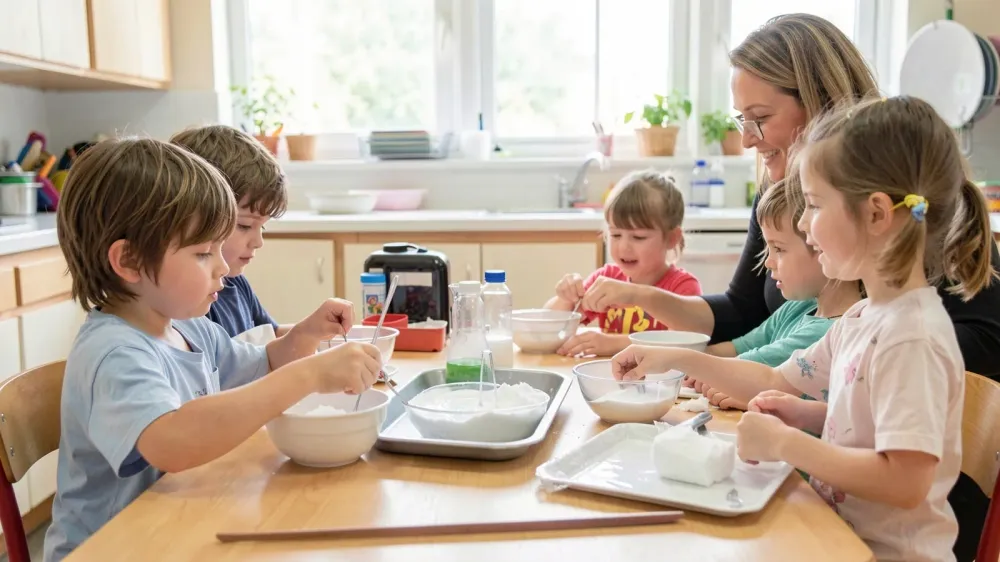
Easy children’s science experiments work when they are small. A single question, a tray you can carry to the sink, and a grown-up who does not wander off to start dinner mid-pour will beat a kit with twenty mystery packets. The aim is to try something, watch what happens, and talk about it in ordinary words. It is not to produce a laboratory, or a mess that outlasts the curiosity.
Children the same age will not handle tools, waiting, or “don’t taste this” in the same way. The CDC’s developmental milestone pages are a useful official reminder of that spread, especially if a younger sibling still mouths objects. For materials, stay in the territory of food-safe kitchen ingredients and water, unless a school or a kit has given you a clear, age-labelled procedure. The U.S. Consumer Product Safety Commission’s Art and Craft Safety Guide is also relevant when you borrow art supplies: no unlabeled chemicals, no solvents or sprays, adults handle anything dusty, food and experiments stay on a planned surface, hands get washed. If something is swallowed that should not have been, call a poison expert. In the United States, Poison Control is 1-800-222-1222, and you can read more at poison.org or on official public-health pages.
This is not a science-fair textbook and not a medical or chemical manual. If a project needs a flame, a strong cleaner, a battery a child could swallow, or a chemical you cannot name, it is not an easy home experiment.
A safety-and-setup table
| Experiment style | Typical materials | What the child can do | What the adult does, and when to stop |
|---|---|---|---|
| Fizz and gas, such as baking soda and vinegar | Baking soda, vinegar, a clear jar or a small bottle, a tray, food coloring only if you accept stained towels | Spoon, pour with a small jug, describe what they see | Keep it on the tray; no tasting as a joke; stop if anyone is rubbing eyes or if the mix is about to go on the floor in a wide arc |
| Water play that asks a question | Water, ice, a sponge, two cups, a sink or a tub | Predict which ice melts first, or which cup holds more, then try it | Wipe spills; no standing water left unattended with a young child; towels ready |
| Sink or float | A bowl of water and a few large, clean objects | Choose an object, guess, test, sort | No tiny objects; nothing that rusts badly or leaks battery acid; dry the table after |
| Growing or waiting | A bean on a wet paper towel in a clear jar, or a cutting in water | Look each day, maybe draw what changed | Wash hands after handling soil or beans; no sprouting things left to rot unnoticed; this is not a lesson in eating raw mystery sprouts |
| Magnet or static, if you already have a fridge magnet | A large magnet and large metal and non-metal objects | Test what sticks | No small magnets, and no magnets near anyone with a medical implant a clinician has warned about; swallowable magnets are a medical emergency, not a toy |
| Outdoor noticing | A walk, a notebook, a leaf or a large pine cone | Collect one or two large finds, draw them | No berries, mushrooms, or unknown plants in the mouth; wash hands; leave living things where they are if you are not sure |
If you buy a kit, read the age label and the warnings as if they were written for your youngest watcher, not for the oldest child in the photograph.
Three easy experiments you can actually finish
Baking soda and vinegar in a jar: put the jar on a tray. Let the child add a spoon of baking soda, then a little vinegar. Watch the fizz. Do it again, a little more slowly, and talk about the bubbles. That is enough. You do not have to name the gas unless you want to, and you do not have to add dish soap, a balloon, and a film crew on the first try. If you do add a balloon later, it is still an adult-supervised setup, not a party trick to scare a younger child.
Ice in two places: one piece on a plate indoors, one in the shade outside, or one in a cup of water and one on a dry plate. Guess which changes first. Look after a snack, not every ten seconds. This is a good experiment for children who do not like sudden fizz.
Sink or float: fill a mixing bowl, gather a spoon, a cork, a stone, a grape, a crayon. Guess, test, sort into two towels. Ask what they notice, and accept “the stone is heavy” as a complete answer. You can come back to it another day with a new object.
A bean in a jar, if you are willing to wait, teaches a different skill: looking again tomorrow. That is worth as much as a dramatic fizz, and it should still be washed-hands science, not a snack.
How to talk about it without giving a lecture
Before you start, ask “What do you think will happen?” Afterward, ask “What did you see?” and “What would you try next?” If the guess was wrong, say so kindly. Being wrong is the usual first step, including for adults who have done the vinegar trick a dozen times and still overfill the jar.
Write one sentence or a drawing if the child wants a record. Date it. A folder of five messy pages is a better “science journal” than a blank book with a grand title.
Keep the session short. When the child is done, you are done. Wash hands, wipe the tray, and put food-like materials away so they are not confused with a snack later. The CPSC’s rule about keeping food and art — or, here, experiments — from turning into the same table is a good one on a school night.
A checklist before you pour anything
- The question is small, and the materials are named and ordinary
- A tray or a sink is ready, and so is a towel
- The experiment is safe for the youngest child who will be in the room
- No flames, no unlabeled cleaners, no button batteries, no tiny magnets
- You will stay for the whole pouring and the whole cleanup
- Hands will be washed, and food will not be served off the experiment tray
- You will stop at curiosity, not at a perfect result
Questions that come up when a kit looks exciting
What age are “easy” experiments for?
It depends on the experiment and on the child. Water and ice can work, with close watching, for younger preschoolers. Anything that fizzes, stains, or involves a small jar needs a closer adult and a child who can accept “we do not drink this.” There is no official badge that makes a five-year-old ready for a chemistry set.
Are kitchen experiments really science?
They can be, if there is a question, a try, and a look at the result. They are also just play, and that is allowed. You do not need to stretch a fizz into a lecture about careers in science for it to have been worth the vinegar.
What should I do if something gets in a child’s eye or mouth?
Rinse as advised on the label if there is one, and get expert help. For suspected poisoning or a swallow that worries you, contact Poison Control or emergency services. Do not wait for a blog, including this one, to invent a home remedy.
Can we use bleach, essential oils, or a science kit meant for older children?
Not as an “easy” home experiment with young children. Strong cleaners and mystery chemicals belong elsewhere. If a kit is labelled for a much older age, believe the label.